
January 28, 2026
•8 min read
•By HM Commercial Systems
Same-day slots in Kuala Lumpur & Selangor · Google rating · Licensed contractor · Hours 9:00–22:00
Comparing thermodynamic lifecycle expenditure, individual tenant sub-metering compliance, and acoustic transmission across premium mixed commercial buildings.
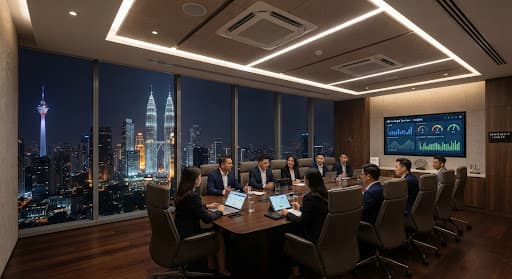
Tenant comfort is a metering and acoustics problem, not only a plant-room choice.
VRV and chilled water fail in different ways when maintenance is deferred.
Landlords in KLCC, Bangsar South, and Damansara often inherit a plant they did not specify. VRV multi-split looks efficient on a brochure because each indoor can modulate. Chilled water looks robust because the chiller is central. Neither survives deferred coil hygiene or ignored condensate in a tropical high-rise.
The right question is not "which is more modern." It is who pays for after-hours cooling, how noise travels through the slab, and whether your contractor can actually service the indoor units without shutting an entire floor.
VRV / VRF moves refrigerant to indoor fan-coil units. Each indoor can be a cassette, ducted FCU, or high-wall. Outdoor inverter modules sit on the roof or a ledge. A single failed outdoor board can take a branch of indoors with it.
Chilled water keeps refrigerant in the plant room. Water is pumped to FCUs. Leaks are water, not refrigerant, which is kinder to occupied floors—but neglected drain pans still stain ceilings, and poorly balanced coils still undercool perimeter offices.
For a single tenant floor plate, VRV is often faster to zone. For a whole podium with 24-hour retail, a maintained chiller loop still wins on simultaneous load.
Tenants fight about electricity. VRV branches can be metered at the outdoor or via indoor energy data. Chilled water needs BTU meters or a fair formula. If after-hours cooling is billed as a lump sum, neither plant will feel "efficient" to the tenant who stays until 22:00.
Fit-out teams that ignore metering lock the landlord into arguments for the next tenancy. We log indoor counts and operating hours during commercial visits so the SLA matches actual use.
Biofilm does not care whether the coil is VRV or chilled-water FCU. Equatorial condensate still fills pans. Cassette lift pumps still fail. Ducted plenums still collect dust if access panels were never cut.
A glossy VRV installation with no chemical-wash window will smell like any neglected split. Schedule indoor work independently of annual chiller overhauls.
Use this as a briefing sheet, not a substitute for a load calculation.
| Condition | Lean VRV / VRF | Lean chilled water |
|---|---|---|
| Many small tenants, fit-out churn | Faster per-unit swap | Heavier riser coordination |
| 24-hour retail podium | Many outdoor modules to maintain | Central plant scales better |
| Acoustic-sensitive boardrooms | Watch refrigerant pipe vibration | Watch FCU and valve noise |
| Existing water risers already in | Usually a poor retrofit | Stay on water, maintain coils |
HM Cooling is not a chiller OEM. We are the indoor, condensate, and branch team that keeps occupied floors dry and quiet while your plant contractor handles the basement machines.
Chemical cleaning and overhaul on accessible indoors, with catchment protection for fitted-out ceilings.
Off-peak windows, SST invoices, and multi-unit rates. For Business coverage is quoted after a walkthrough.
Select Business on the visit form and list indoor count. Diagnostic rates start from the published commercial band.
Designing adequate inspection manholes (minimum 600x600mm) and choosing antimicrobial fiberglass acoustic lining to eliminate invisible dust reservoir creation.
Why ground-floor properties face higher coil bio-fouling from lawn fertilizers and garden soils, while high-rises suffer condenser wind-tunnel thermal resistance.
An engineering perspective on biofilm accumulation, microbial degradation, and the thermal efficiency penalty of deferred coil cleaning in equatorial Southeast Asia.
Book a commercial visit. We log indoor condition, drains, and after-hours pain points, then quote an SLA that matches the building you actually have.
Off-peak slots available · Formal commercial invoicing